 How-to
How to Check a Product's Social Impact Before Buying
Last Updated: November 16, 2026
Quick Summary
To check a product's social impact before buying, look past price and quality to who made it and under what conditions. Start with the brand's named suppliers and impact report, confirm any certification on the certifier's own website, and trace the supply chain beyond the first factory. Missing information is itself a warning sign.
- Check whether the brand names its factories, farms or at least their countries.
- Confirm certifications on the certifier's own website, since logos alone can mislead.
- Look for wage, hour and safety data in the impact report, not just aspirational statements.
- Trace second- and third-tier suppliers, such as fabric mills or farms, not only the first factory.
- Treat a missing answer about who made the product as a finding in itself.
Table of Contents
- What Social Impact Means for a Product and Why It Matters
- How to Identify Ethical Brands Before You Spend
- A Step-by-Step Checklist for Assessing a Product's Social Impact
- Reading Labels and Certifications Without Being Misled
- Fair Trade Products: What the Label Covers and What It Doesn't
- Spotting Greenwashing and Purpose-Washing Before You Buy
- Using Ethical Shopping Apps to Speed Up Your Research
- Booking Your First Ethical Check: Start With One Product You Buy Often
- Frequently Asked Questions
What Social Impact Means for a Product and Why It Matters
Social impact is the effect a product has on people, from the workers who make it to the communities where it is sourced and sold. Extending this scrutiny to the items we purchase for our animals is equally vital, as verifying pet product quality ensures that our ethical standards remain consistent even when shopping for our companions.
At eb™ Scan App, we look at social impact as one part of a wider picture.
Social impact is about who is affected. It asks whether workers were paid fairly, whether communities gained or lost, and whether the supply chain treats people with respect.
Here is why it matters:
- Workers may face unsafe conditions or low pay that never shows on the label.
- Communities near factories or farms can gain jobs or pay a price in health and land.
- Supply chains often hide the hardest jobs several steps away from the brand's name.
The gap between what a brand says and what it does is where most mistakes happen. Checking the facts yourself closes that gap.
How to Identify Ethical Brands Before You Spend
Start by asking one simple question: does the brand explain how it treats people, or does it only talk about style?
Look for these signs of a brand that takes social impact seriously:
- It names its factories or farms, or at least the countries they are in.
- It publishes a supplier list or a yearly impact report.
- It explains how workers are paid, not just that it "cares."
Be careful with brands that rely on vague words. Phrases like "conscious," "natural," or "for good" sound caring but say little.
Use an ethical shopping app to compare brands quickly. You can scan a barcode, QR code or logo and see its rating before you commit.
A Step-by-Step Checklist for Assessing a Product's Social Impact
Most guides tell you to 'check the brand's values' without saying where to look. This checklist is different: each step names a specific source or question you can act on today. You do not need to complete every step for every purchase.
- Start with the product page and the brand's own site. Note the country of manufacture, the named supplier (if any), and whether the brand publishes a supplier list or an annual impact report. Compare product quality and ethics side by side with a fuller seven-step method. A brand that names its factories or farms is easier to verify than one that only says 'responsibly made'.
- Search the brand's impact report for worker-related data. Look for numbers on wages, hours, safety incidents, and audit findings, not just aspirational statements. If the report only describes future goals, treat it as a statement of intent rather than evidence.
- Check independent certifications on the certifier's own website. Do not rely on the logo on the pack. Go to the certifier's site and confirm the certificate is current and covers the specific product or facility you are buying. certification lookup directories
- Trace the first tier of the supply chain. Ask who made the product and under what conditions. Look for the name of the factory, the country, and whether the brand discloses audit results. A brand that can name its first-tier factory but not the farms or mills behind it has not checked the whole chain.
- Look for second- and third-tier disclosure. For clothing, this means fabric mills and raw-material sources. For food, it means farms and cooperatives. Few brands publish this, but those that do tend to be more credible on labour claims.
- Check community and land impacts. Search for the brand name alongside terms like 'land rights', 'water use', 'displacement', or 'community consultation'. Watchdog organisations and local news outlets often report what brands leave out.
- Compare two similar products side by side. One product in isolation is hard to judge. Two products with different certifications, supplier disclosures, or price points make the trade-offs visible.
- Note what you cannot find. Missing information is itself a finding. If a brand cannot answer basic questions about who made the product, that absence should inform your decision.
Watch out: a brand's own impact report is marketing material, not an independent audit. Treat it as a starting point for questions, not as proof.
Tracing the Impact on Workers, Communities and Supply Chains
Follow the product back to its start. Most products pass through many hands before they reach a shelf, and each link can affect people differently.
Focus on three areas:
- Workers: Are wages, hours and safety standards stated? Are workers free to organise? Look for named factories and audit summaries rather than general statements about 'fair treatment'.
- Communities: Does production bring jobs, or does it strain water, land or local services? Local news and NGO reports often cover disputes that brands do not mention.
- Supply chains: Does the brand know its second- and third-tier suppliers, or only the first? A brand that can name its first-tier factory but not the farms behind it has not checked the whole chain.
Checking Who Benefits Along the Way
Ask who gets the money. A fair price for the product should reach the people who did the work, not only the brand.
This question often reveals more than any label. A product can sound ethical while most of its profit goes to a distant owner.
The checklist above can be scanned at a glance, so here is each step with the source to check and what to look for.
| Step | Where to look | What to look for |
|---|---|---|
| 1. Start with the product page | Product page and brand site | Country of manufacture, named supplier, supplier list or impact report |
| 2. Search the impact report | Brand's impact report | Wages, hours, safety incidents, audit findings |
| 3. Check certifications | Certifier's own website | Current certificate covering the specific product or facility |
| 4. Trace the first tier | Brand disclosure | Factory name, country, audit results |
| 5. Look for second and third tiers | Brand disclosure | Fabric mills, raw-material sources, farms, cooperatives |
| 6. Check community impacts | Local news and NGO reports | Land rights, water use, displacement, consultation |
| 7. Compare two similar products | Both product pages | Differences in certification, disclosure and price |
| 8. Note what you cannot find | Your own notes | Missing answers about who made the product |
Reading Labels and Certifications Without Being Misled
Certifications can help, but they are not all equal. See the specific visual and wording signs that suggest greenwashing on packaging. Some check real working conditions across a whole facility. Others verify a single ingredient, a single farm, or a single environmental attribute. Knowing the difference is the skill this section teaches.
When you see a label, ask four questions:
- Who issued it? An independent body is more trustworthy than the brand itself. Self-declared labels and 'memberships' are not certifications.
- What does it measure? Find out whether it covers workers, the environment, or both. A label that only addresses packaging does not tell you about labour conditions.
- Does it cover the whole product? A label on one ingredient, such as cocoa or cotton, does not cover the rest of the product. Check the scope statement on the certifier's site.
Comparing Common Certification Types and Their Limits
Different schemes verify different things. A useful way to compare them is by scope and by what they do not cover.
- Fair trade schemes (for example, Fairtrade International) set a minimum price and a premium for community projects, usually for a specific commodity such as coffee, cocoa or bananas. They do not guarantee that every worker in a multi-ingredient product is treated well, and they may cover only one ingredient.
- Labour-focused schemes (for example, SA8000 or Fair Wear Foundation membership) concentrate on working conditions, wages and freedom of association at named facilities. They typically cover first-tier factories rather than raw-material suppliers.
- Multi-attribute schemes (for example, B Corp certification) assess a company's overall social and environmental performance, including governance and worker policies. They say less about a specific product's supply chain than about the company as a whole.
A common pattern is that the more specific the claim, the easier it is to verify. 'Fairtrade cocoa' tells you something checkable about one ingredient. 'Ethically made' tells you almost nothing.
What Certifications Do Not Tell You
Even a credible certification has limits. It may rely on announced audits, which can miss problems between visits. It may cover a facility but not the labour recruiter who hired the workers.
Use certifications as one input, not a verdict. Combine them with the supplier disclosure and worker questions in our checklist.
Watch out: a small logo on the front of a pack may refer to only one ingredient or one facility.
Fair Trade Products: What the Label Covers and What It Doesn't
They do not cover everything. A fair trade label may apply to one ingredient, such as cocoa or coffee, while the rest of the product is made elsewhere. It also does not guarantee every worker in the chain is treated well.
Use fair trade as a strong starting point, then check the other points in our checklist. Ask whether the brand supports its producers beyond the label.
Spotting Greenwashing and Purpose-Washing Before You Buy
Greenwashing is when a brand makes environmental claims that are exaggerated or unproven (Green claims - Environment). Purpose-washing is the same problem applied to social claims, where a brand uses caring language without showing real action.
Watch for these warning signs:
- Vague claims like "eco-friendly" or "made with love" with no evidence.
- Big promises about the future with no current data.
- Certifications that are self-issued or impossible to verify.
When a claim sounds too good, look for the evidence. A credible brand can usually point to a report, a named partner, or an independent audit.
Using Ethical Shopping Apps to Speed Up Your Research
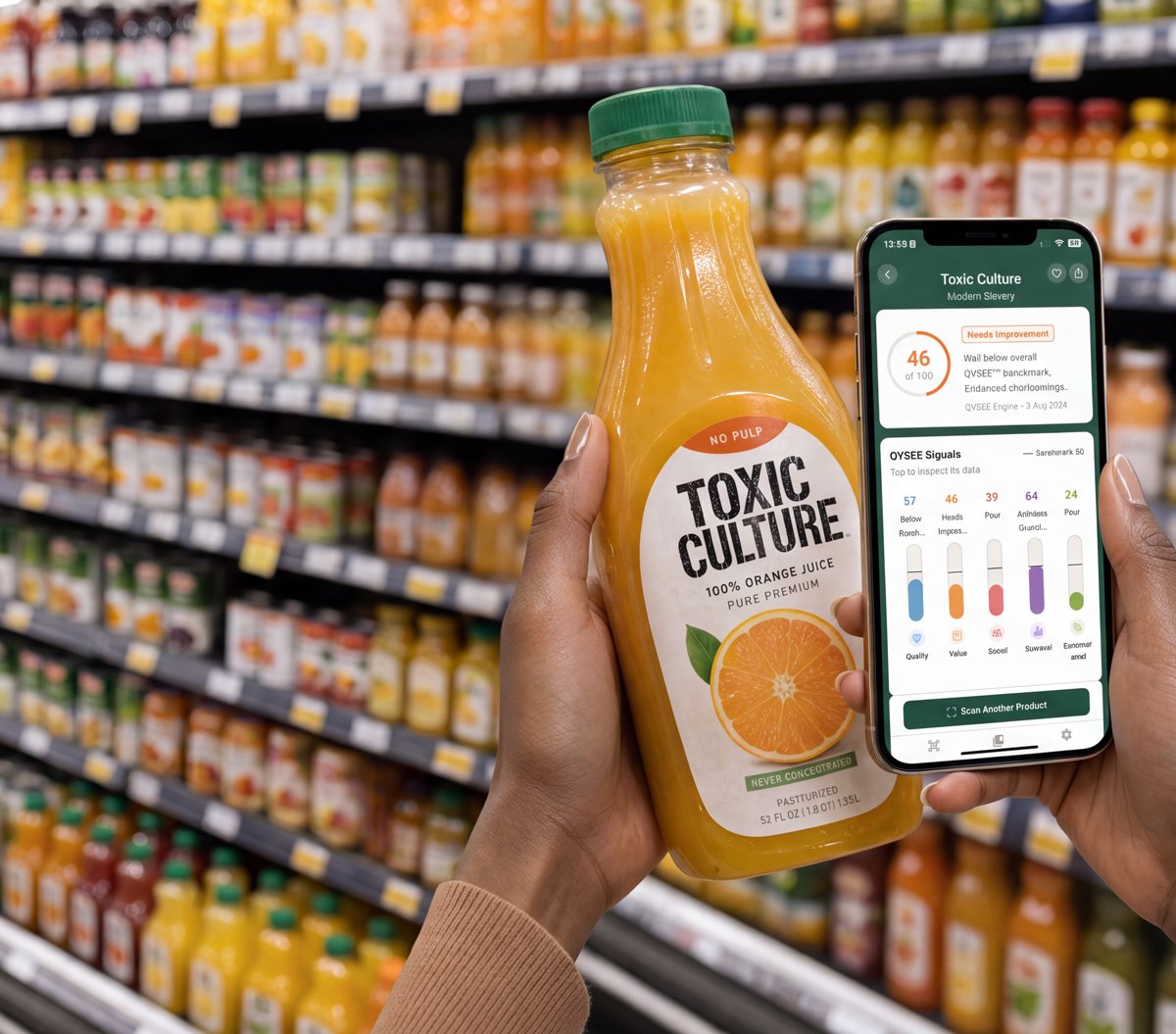
Checking every product by hand takes time. The eb™ Scan App lets you scan a barcode, QR code or logo and see a rating built on Quality, Value, Social, Economic and Environmental impact. Learn how to scan products for ethical information quickly.
Remember that an app is a starting point. Use its rating to narrow your choices, then check the details that matter most to you. Compare four alternatives to Buycott for ethical shopping.
Booking Your First Ethical Check: Start With One Product You Buy Often
Do not try to check everything at once. Pick one product you buy regularly, such as coffee, clothing or snacks, and run through the checklist for that one item.
Here is a simple way to begin:
- Choose one everyday product.
- Scan it or look up the brand's supplier information.
- Check one certification and one worker-related fact.
Repeat this with one new product each week. Over time, your habits change without much extra effort.
Frequently Asked Questions
How can I check a product's social impact before buying online?
Start with the brand's own published reports on supply chains, pay and working conditions, then look for independent verification such as third-party certifications or audits. Check whether the claims are specific and measurable or only general statements of intent. Cross-check the brand against independent rating platforms and news coverage. If the brand discloses its factories or suppliers, look up their conditions too. Vague language and missing evidence are usually signals to dig further before you buy.
What evidence should I look for when assessing a brand's ethical claims?
Look for named certifications with publicly listed standards, independent audit results, and clear data on wages, working hours, and supplier locations. Specific figures tied to a stated year and method are more credible than broad claims like 'sustainable' or 'responsibly made'. Check whether the company has been reviewed by an outside body and whether it explains what it has not yet achieved. Evidence trails that you can follow back to source are the strongest signal.
Can an app help me check a brand's ethical credentials?
Yes. Ethical shopping apps such as the eb™ Scan App bring together ratings and evidence about brands in one place, so you can compare credentials at the point of purchase rather than searching multiple sites. Apps are most useful as a starting point. Use them alongside a brand's own disclosures and independent certifications, and check whether the app shows its evidence trail so you can verify the rating yourself.
Which certifications can help me assess a product's social impact?
Read what any certification actually measures before relying on it, and check whether it covers the whole product or only one part of the supply chain. A certification is a useful signal, not a complete guarantee of a product's overall social impact.