 How-to
7 Steps to Verify Ethical Product Claims Before You Buy
Last Updated: 22 November 2026
Quick Summary
To verify ethical product claims, read the exact wording and turn each promise into a checkable fact, then confirm any certification with the body behind it and check the certificate covers your product. Ask which supply-chain tier the evidence covers and treat missing evidence as unproven.
- Vague labels such as eco-friendly cannot be checked, so treat them as decoration.
- Check who operates a scheme, what it audits, whether the audit is independent and whether a public register exists.
- Mass balance is weaker than identity preserved or segregated chain of custody.
- A Tier 1 factory audit covers assembly, not the raw material behind an ethically sourced claim.
- Report misleading environmental claims in the UK to the Advertising Standards Authority or Trading Standards.
Table of Contents
- Why Ethical Product Claims Need Verifying
- Start With the Wording: What Ethical Product Labels Actually Say
- How to Spot Greenwashing on Packaging and Product Pages
- Check the Certification, Not Just the Logo
- Follow the Ethical Sourcing Trail Through the Supply Chain
- Use an Ethical Rating Website to Compare Evidence
- When Evidence Is Missing or a Claim Looks Misleading
- Scan the Next Product You Pick Up
- Frequently Asked Questions
Why Ethical Product Claims Need Verifying
Most shoppers assume a green leaf on a bottle means something. It usually means the marketing team chose a nice shade of green.
The stakes are higher than a wasted purchase.
So the question is not whether brands make ethical claims. It is which ones survive scrutiny.
Below, we show you exactly how to check a claim, step by step, and what to do when the evidence simply is not there.
Start With the Wording: What Ethical Product Labels Actually Say
Read the claim as a lawyer would. Ethical product labels are written by marketing teams, not auditors, so the exact words matter more than the design.
Take the label in your hand and ask one question: what, precisely, is being promised?
Vague Claims vs Specific Claims
A vague claim sounds good and says nothing. A specific claim can be checked.
| Vague claim | Specific claim | Why it matters |
|---|---|---|
| "Eco-friendly" | "Made from 100% recycled polyester" | One is a mood, one is a material fact |
| "Sustainable sourcing" | "Fairtrade-certified cocoa" | One names a standard you can look up |
| "Kind to the planet" | "Carbon neutral across Scope 1 and 2 emissions" | One has a boundary, one has a slogan |
| "Ethically made" | "Audited by [named scheme] in 2025" | One names a verifier and a date |
If a claim cannot be turned into a checkable fact, treat it as decoration.
How to Spot Greenwashing on Packaging and Product Pages
Greenwashing hides in plain sight, and packaging is where it often appears. The tell is almost always a gap between the size of the promise and the size of the evidence.
UK Competition and Markets Authority guidance on environmental claims makes the principle clear: claims must be truthful, clear, and backed by evidence. That is the standard to hold packaging to.
Warning Signs to Check First
- A logo with no name. A green swirl proves nothing unless it belongs to a recognised scheme.
- One good attribute, one big implication. "Recyclable bottle" says nothing about the contents.
- Comparatives with no baseline. "Greener than before" compared to what, exactly?
For a deeper walkthrough of the packaging signals that give greenwashing away, see our guide to signs of greenwashing in product packaging.
Check the Certification, Not Just the Logo
A certification is only as good as the body behind it. Anyone can draw a tick. The question is who awarded it, against what standard, whether an independent third party checked, and whether the certificate actually covers the item in your hand.
The Five Questions That Test a Scheme
Work through these in order. If any answer is no or cannot be found, treat the logo as decoration.
- Who operates the scheme? Name the organisation. Is it a standards body, an industry association, a charity, a government-backed scheme or a brand's own in-house label? In-house labels are not independent verification, however good the artwork.
- What does it actually audit? A scheme may audit environmental management, labour conditions, animal welfare, chemical restrictions, chain of custody or a combination. A certification that covers energy use says nothing about factory wages.
- Is the audit independent? Look for a named accredited certification body, not the brand's own sustainability team. Independence means the auditor is paid by the scheme or the certifier, not directly by the brand being audited, and that the auditor's findings are subject to their own accreditation.
What Credible Schemes Publish
The ISEAL Code of Good Practice for sustainability claims sets out what credible standards should require, including independent verification, public reporting and a complaints mechanism. In practice, a scheme worth trusting tends to publish:
- its standard documents and the version currently in force;
- its assurance manual, showing how audits are conducted and how often;
- a list of accredited certification bodies;
If a scheme publishes none of these, the logo is a marketing asset rather than a verification tool.
Chain of Custody: The Bit Most Shoppers Miss
Chain of custody is the documented trail linking certified material or a certified process to the finished product. It matters because a certified farm, factory or fishery does not automatically make the product in your hand certified. There are three common models, and they mean different things:
- Identity preserved, certified material is kept separate from uncertified material all the way through the supply chain. The strongest claim.
- Segregated, certified and uncertified material are kept in separate streams but may be mixed within the certified stream. The product contains certified material, but not necessarily from one source.
- Mass balance, certified and uncertified material are mixed, and the scheme administers a credit or volume balance. The product may contain little or no physically certified material, even though the brand has purchased the equivalent volume of credits.
Mass balance is legitimate under several schemes, but it is weaker than identity preserved or segregated. If a brand claims a product is 'made with certified cocoa' or 'certified sustainable palm oil', ask which chain-of-custody model applies.
Watch out: a logo on the front of a pack may refer only to the packaging, only to one ingredient, or only to the parent company's global commitment, always check the scope statement before treating it as a product-level claim.
For a practical method of testing whether a specific claim holds up, see our guide on how to check brand sustainability claims.
Follow the Ethical Sourcing Trail Through the Supply Chain
Ethical sourcing claims are the hardest to check and the easiest to exaggerate. A brand can control its own factory and still know nothing about the mill three steps back. Most competitor guidance stops at environmental sourcing; the broader ethical question covers labour conditions, animal welfare and human rights as well, and those claims need a different evidence trail.
Ask for the trail, not the story.
Map the Tier Before You Judge the Claim
Supply chains are usually described in tiers, and the tier a claim covers tells you how much of the product it actually speaks for:
- Tier 1, final assembly or manufacturing, often the factory that ships the finished product.
- Tier 2, component or material processing, such as fabric mills, tanneries or electronics assemblers.
- Tier 3 and beyond, raw material extraction or production: farms, mines, forests, fisheries and the first-stage processors.
A factory audit at Tier 1 is common and relatively easy to obtain. A claim about raw material, cotton, cocoa, palm, cobalt, leather, depends on Tier 3 and beyond, which is where visibility usually collapses. When a brand says 'ethically sourced', ask which tier the evidence covers. If the answer is Tier 1 only, the claim is about assembly, not sourcing.
Match the Claim to the Right Evidence
Different ethical claims need different proof. A generic 'ethical' badge is not enough; the evidence should match the specific promise.
- Labour and human rights, look for a named social-audit standard, a published code of conduct, audit summaries (not just a pass/fail badge), grievance mechanisms and evidence of remediation when issues are found. A self-assessment questionnaire is not an audit. A factory audit covers one site, not the raw material behind it.
- Animal welfare, look for species-specific welfare standards, whether they are independently audited, and whether the claim covers the whole product or one ingredient (for example, 'free-range eggs' used in one component of a multi-ingredient product).
- Sourcing and deforestation, look for a named sourcing standard, a cut-off date for deforestation-free commitments, and chain-of-custody documentation linking the certified material to the product.
A common mistake is accepting a single factory audit as proof of ethical sourcing. It usually covers one site, one shift pattern and one point in time, not the raw material or the workers further upstream.
Read the Audit for What It Does Not Say
Audits are snapshots. A credible brand will tell you:
- who conducted the audit and under what standard;
- whether it was announced or unannounced;
- what the scope was, site, product, material or process;
A brand that publishes only the word 'audited' has told you almost nothing.
Watch out: a supplier's own certificate of compliance is not the same as an independent audit, self-declared conformity is common in supply chains and should be treated as a starting point, not proof.
If you want to see how these trails feed into a single evidence-based score, our guide on how to check brand sustainability claims sets out the method.
Use an Ethical Rating Website to Compare Evidence
An ethical rating website saves you the legwork by pulling scattered evidence into one score. The value depends entirely on how the rating is built.
At Ethical Brand, our QVSEE™ rating engine assesses brands across Quality and Value plus Social, Economic and Environmental impact. Because strengths in one area can mask weaknesses in another, vetting eco friendly brands means weighing their environmental claims alongside their social and economic impact.
When comparing any rating, ask:
- What does the score actually measure?
- Is the methodology published?
- How often is the data updated?
If you want to know how trustworthy the ratings themselves are, read our guide to ethical ratings accuracy and verification.
When Evidence Is Missing or a Claim Looks Misleading
Absence of evidence is itself information. If a brand cannot or will not show its workings, treat the claim as unproven.
Here is what to do, in order:
- Check the brand's own site for a sustainability or sourcing page with named standards.
- Search the certifier's register for the licence number.
- Ask the brand directly and note whether the answer is specific.
- Compare the claim against a rating that shows evidence.
- If a claim still looks misleading, report it.
In the UK, misleading environmental claims can be reported to the Advertising Standards Authority or to Trading Standards. Our guide on how to report greenwashing by a company in the UK walks through the process.
Watch out: a brand that answers a direct question with another slogan has told you something useful.
Scan the Next Product You Pick Up
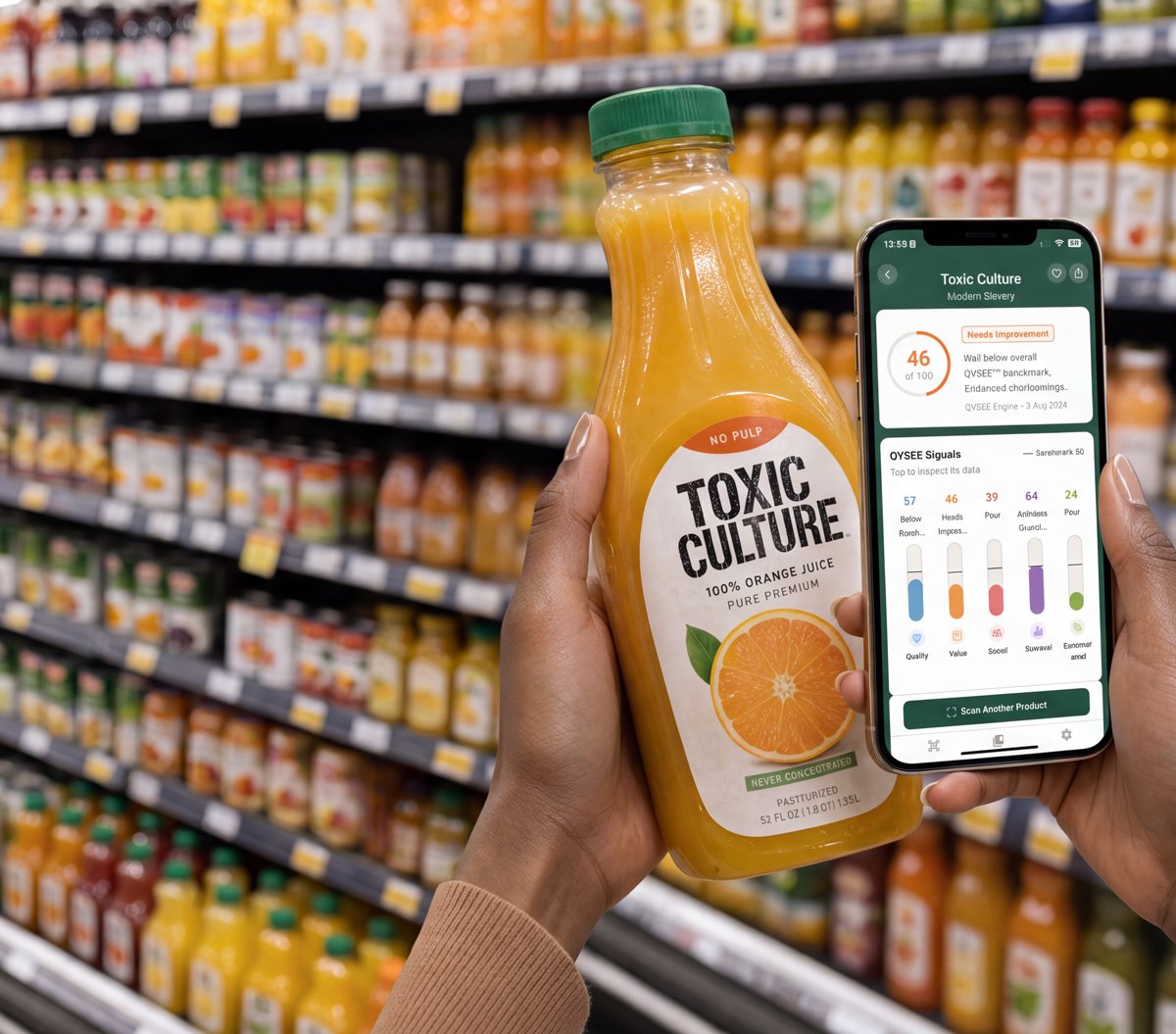
Verification only works if you actually do it, and doing it in the aisle takes seconds when you have the right tool.
If you want to put these steps into practice, our guide on how to scan products for ethical information shows you exactly how.
The gap between a claim and its evidence is where greenwashing lives, and closing it is a habit rather than a one-off check.
Frequently Asked Questions
How can I check whether a brand's ethical claims are reliable?
Work claim by claim rather than trusting the brand as a whole. Read the exact wording on the pack or product page, then look for the certification behind it and confirm the certifying body is independent. Ask what the claim covers: one product, one ingredient, or the entire supply chain. If a brand cannot show documentation, treat the claim as unverified. A structured checklist and a rating tool that records evidence make this quicker than starting from scratch each time.
What evidence should a company provide for ethical product claims?
Expect specific documentation rather than slogans. For environmental claims, that means certification numbers, recycled content percentages, and carbon data broken down by Scope 1, Scope 2 and Scope 3 emissions. For ethical sourcing, look for third-party audit reports, supplier lists, and named recognised standards covering labour and human rights. For animal-welfare claims, ask which standard applies and who verifies it. If the only evidence is marketing language on the brand's own site, the claim is not yet substantiated.
How can I spot greenwashing on product packaging?
Greenwashing usually shows up as vagueness. Watch for words like natural, eco-friendly or green with no definition, imagery of leaves and forests standing in for data, and claims that highlight one small good feature while ignoring the product's main impact. Check whether a compostable or recycled claim covers the whole item or just the packaging, and whether a certification logo belongs to a recognised standards body or was designed in-house. If the claim cannot be checked, it is doing marketing work rather than informing you.
Are ethical rating websites reliable for verifying claims?
Reliability depends on whether the site shows its methodology and evidence. A useful ethical rating website explains how scores are calculated, covers social and environmental criteria together, and updates ratings when a brand's practices change. Look for evidence trails you can inspect rather than a single number with no explanation. The eb™ Scan App, for example, uses its QVSEE™ rating engine to assess Quality, Value, Social, Economic and Environmental impact, and you can download and try it free before deciding whether to subscribe.